Inspectable evidence
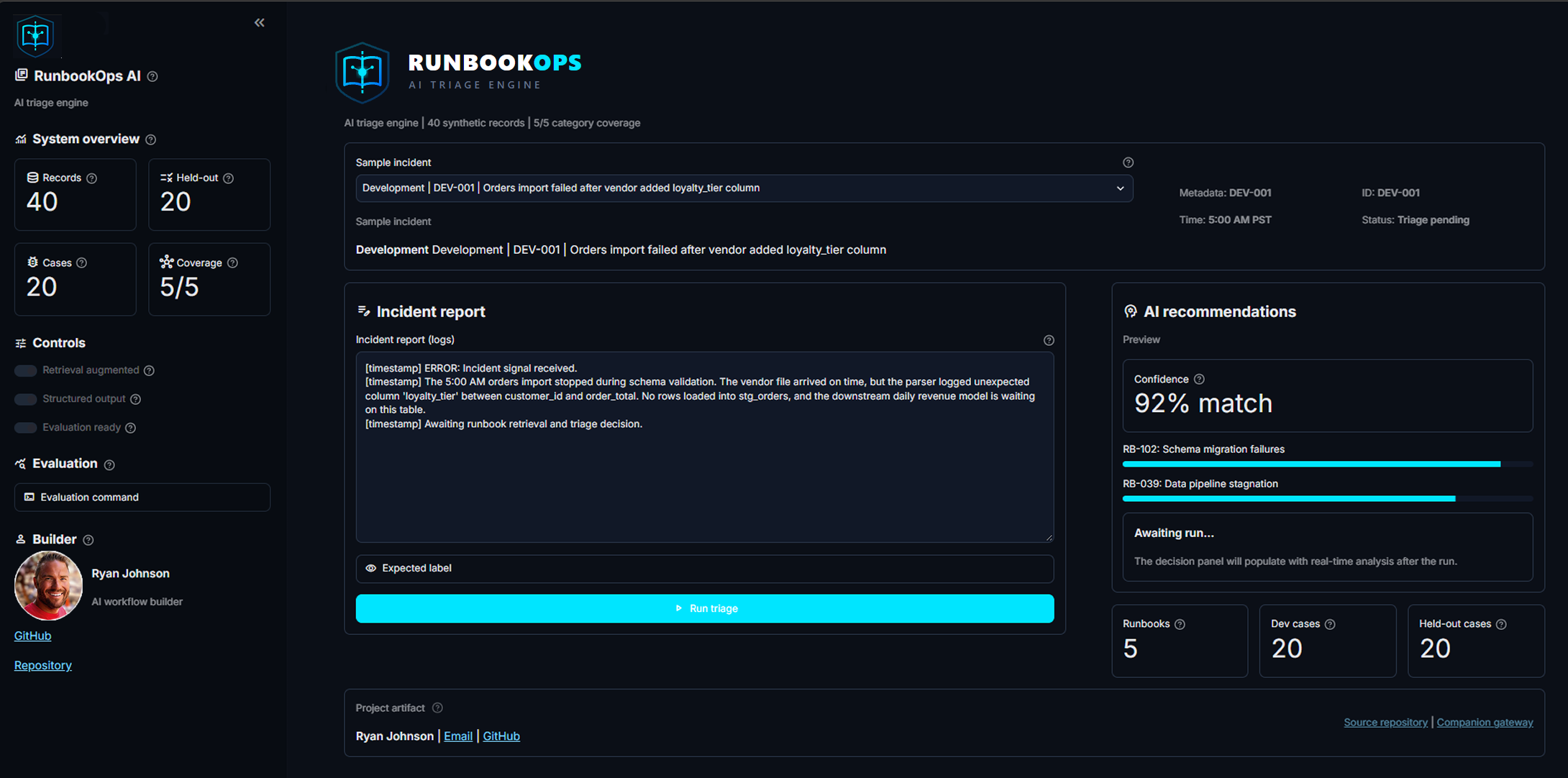
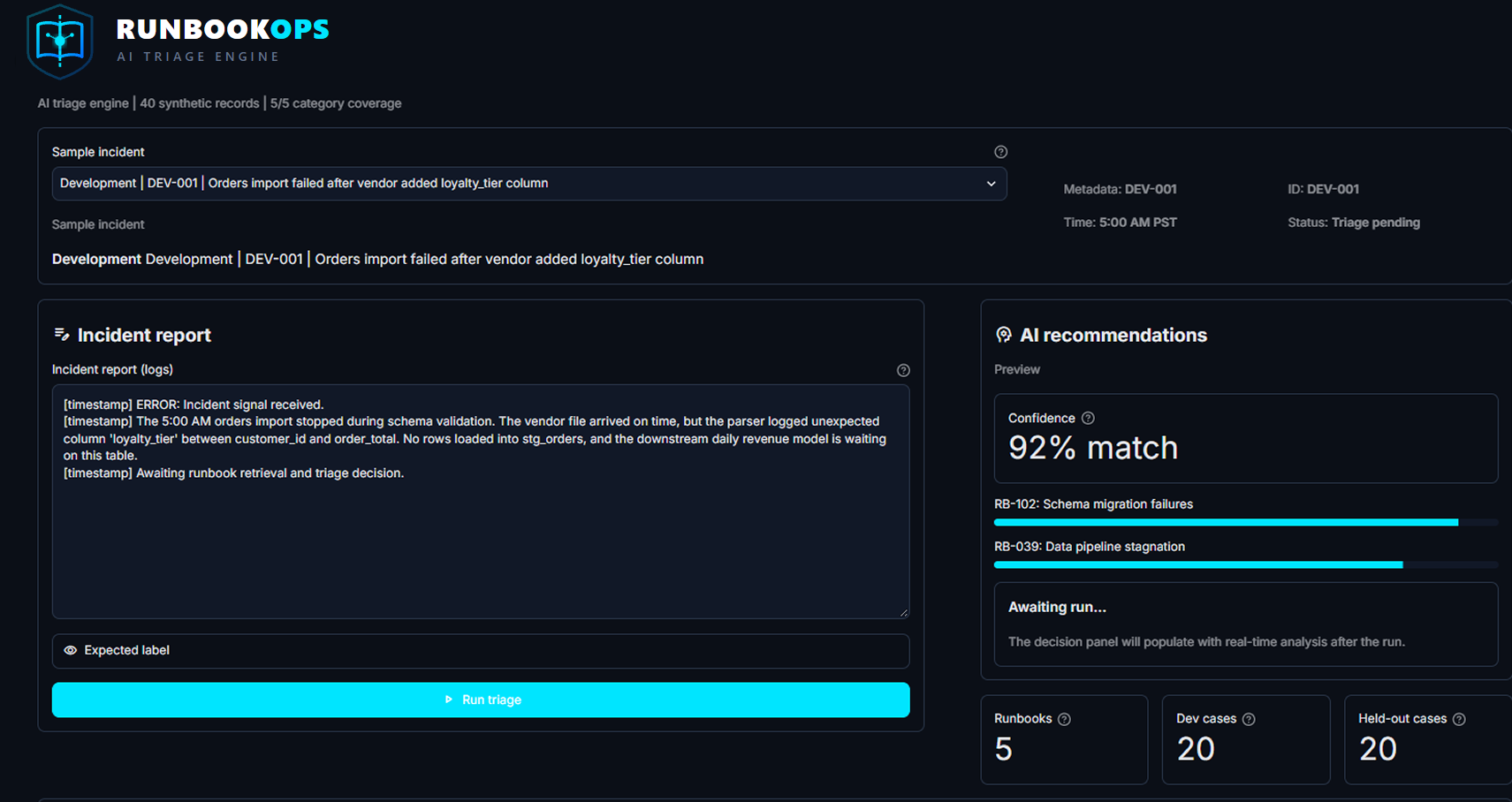
Every result can expose retrieved evidence, cited runbooks, structured output, prompt preview and the route reason.


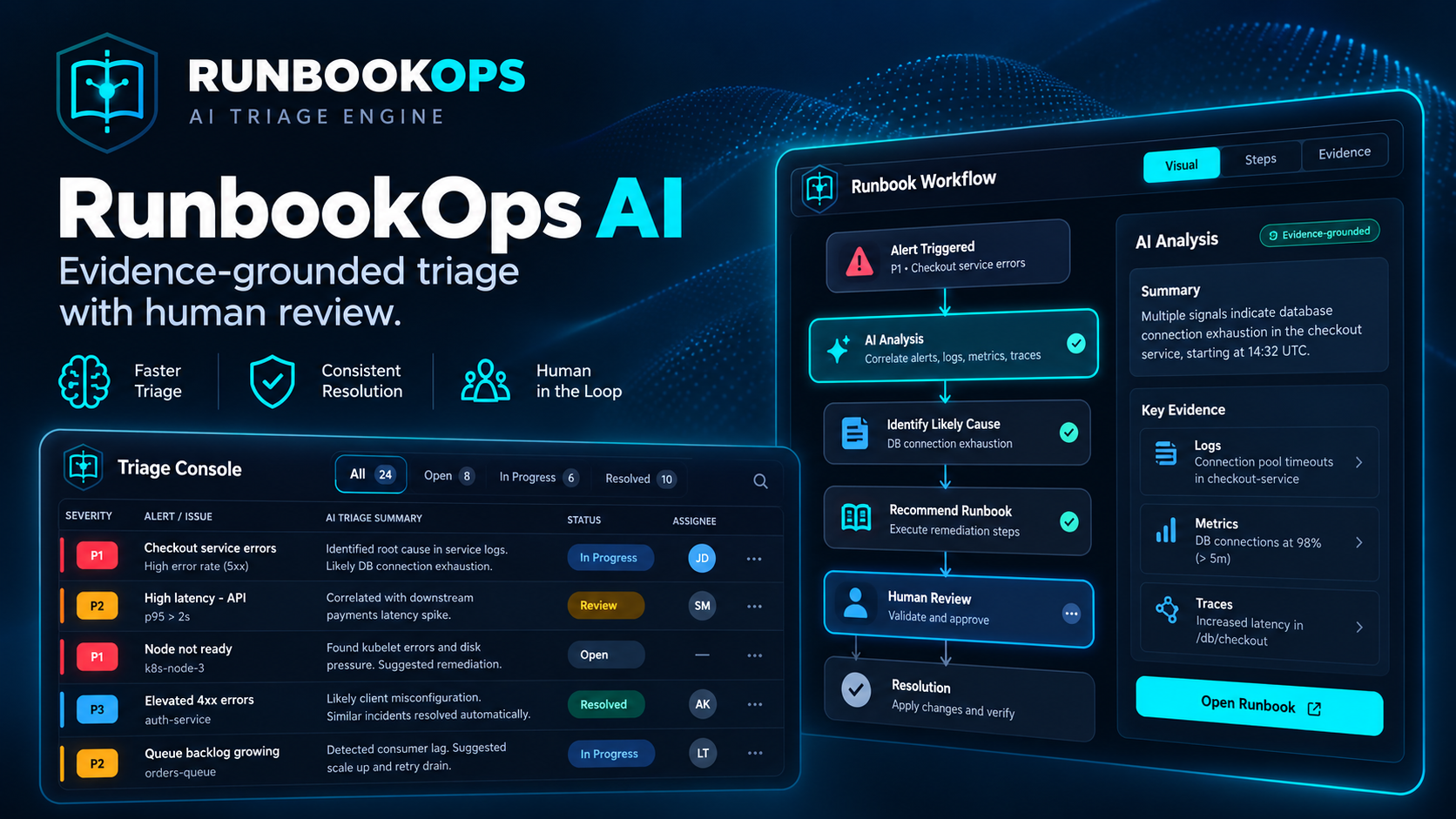
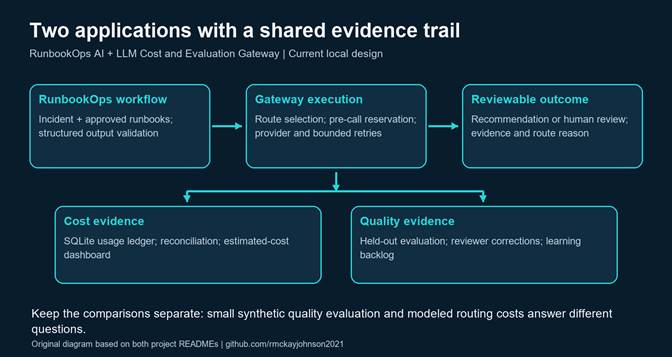
RunbookOps AI is a working local triage console for synthetic data-pipeline incidents. It combines approved runbook retrieval, structured model output, deterministic calibration, human-review routing and held-out evaluation.
Rank relevant snippets and preserve cited evidence.
Model output is constrained to a testable schema.
Category, severity and review route are checked outside the model.
Unclear or risky cases remain with a person.
Operational teams can have approved knowledge and still struggle with noisy incident notes, ambiguous symptoms and time pressure. RunbookOps demonstrates a workflow that retrieves relevant runbook evidence, asks a model for a structured recommendation, validates the response and applies deterministic safeguards before deciding whether automation is appropriate.
Operator supplies or edits the synthetic incident narrative.
Relevant approved snippets and matched terms become evidence.
Model response is validated into category, severity, summary, evidence and recommendation.
Clear evidence can yield a recommendation; uncertainty becomes human review.
Accept, edit or reject the triage result.
Adjust category or severity and tag the reason.
Propose runbook updates when guidance is missing.
Promote cases into a future held-out backlog.
The workflow routes unclear or risky cases to human review instead of pretending every incident is automatable. Review is required for missing evidence, ambiguous first failure, multi-system impact, suspected corrupt source data, security/access/audit/payroll concerns, or attempts to override workflow instructions.
Rank approved runbook snippets.
Ask the model for structured triage output.
Apply schema validation and deterministic calibration.
Approve clear cases or send uncertain cases to people.
Capture reviewer corrections for future runbooks and evals.
The repository separates 20 development incidents from 20 held-out incidents across five categories, then reports category accuracy, severity accuracy, runbook match and review-routing performance.
Every result can expose retrieved evidence, cited runbooks, structured output, prompt preview and the route reason.
Accept, edit or reject results; correct category/severity; propose runbook updates; and promote cases into a future evaluation backlog.
Use RunbookOps as a reference pattern for retrieval, structured output, guardrails, review routing and evaluation.